
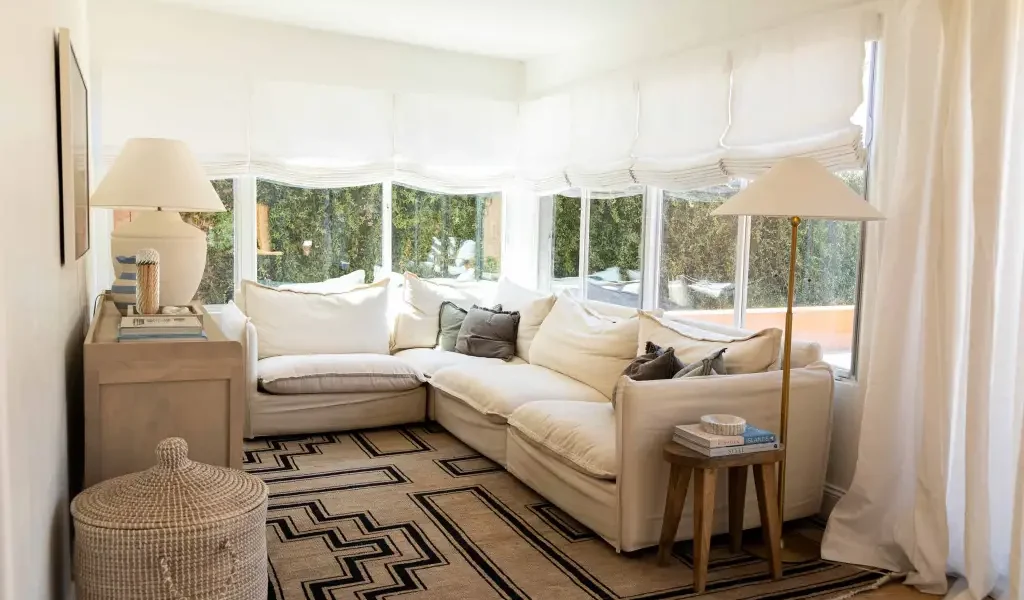
How Roman Shades Can Make Small Rooms Feel More Polished
Small rooms have a way of making every design decision feel magnified. In a spacious interior, a slightly oversized piece of furniture or a visually busy window treatment can often disappear into the overall composition. In a compact room, every element has a much bigger role to play.
Windows are particularly important because they occupy valuable wall space while also influencing natural light, privacy, and the perceived proportions of the room. The right treatment can make a small room feel calmer, taller, and more intentional. The wrong one can make it feel crowded.
This is where roman shades have a distinct advantage.
Their tailored silhouette takes up relatively little visual and physical space while still introducing fabric, color, texture, and softness. When thoughtfully chosen, roman shades can make even a compact bedroom, dining nook, home office, or living room feel considerably more polished.
Why Roman Shades Work So Well in Small Rooms
Traditional curtains can be beautiful in small spaces, but they require wall space on either side of the window to accommodate the panels. When open, the fabric needs somewhere to stack. When closed, full-length curtains can become another large visual element in an already compact room.
Custom roman shades take a different approach.
They fit neatly within or around the window, creating a clean architectural shape without extending far into the room. When raised, the fabric folds into a compact stack. When lowered, it provides a soft textile surface without requiring floor-to-ceiling fabric.
That makes them particularly useful when every inch of space matters.
Keep the Silhouette Clean
A small room benefits from visual clarity.
Roman shades naturally provide that because their construction creates a defined, tailored shape. Instead of introducing long vertical panels that may compete with furniture or architectural details, the shade follows the proportions of the window.
This can make the room feel more deliberate.
Choose a style with clean lines and avoid unnecessary decorative details if the room is already visually busy. A simple shade in a beautiful fabric can have much more impact than an elaborate treatment competing with a small space.
The luxury comes from proportion and material rather than excess.
Use Color to Make the Room Feel Larger
Color can dramatically influence how a window treatment relates to the surrounding room.
A roman shade that closely echoes the wall color can create a continuous visual field, making the window feel integrated rather than highlighted. This can be particularly effective in very small rooms where you want to avoid creating too many distinct blocks of color.
A soft ivory shade against warm white walls, for example, can create subtle depth without visually chopping up the wall.
You can also introduce gentle contrast. A taupe shade against a cream wall or a soft gray against a warmer neutral can give the window definition while maintaining a calm palette.
The key is to avoid creating contrast simply for the sake of contrast.
Texture Adds Interest Without Clutter
Small rooms do not have to be devoid of texture.
In fact, texture can be one of the best ways to make a compact space feel sophisticated without making it feel busy. A woven linen, slubby cotton, subtle herringbone, or tactile neutral fabric can give the roman shade depth without introducing a strong pattern.
This is particularly effective in minimalist and neutral interiors.
The shade may look relatively simple from across the room, but as daylight moves across the fabric, the weave becomes more apparent. The window gains dimension without demanding attention.
It is a subtle design trick, but an effective one.
Choose Pattern Carefully
Pattern can absolutely work in a small room, but scale matters.
A large, high-contrast pattern can make a small window feel even more visually prominent. That may be exactly what you want if the window is intended to be a focal point, but it can also overwhelm a compact room.
Smaller-scale patterns, tonal prints, and low-contrast designs are generally easier to integrate.
A delicate botanical can add personality to a small bedroom. A subtle stripe can introduce structure. A small check can bring charm to a kitchen or breakfast nook.
If the room is already decorated with patterned wallpaper, upholstery, or a statement rug, however, consider allowing the roman shade to remain relatively quiet.
Pattern Placement Matters
The scale of the window does not only determine which pattern you choose. It also affects how that pattern will appear.
A large-scale motif can be beautiful on a wide roman shade but may become awkwardly cropped on a narrow window. Because the fabric folds when the shade is raised, important parts of the design can also disappear.
This is where custom roman shades can be especially useful.
A custom treatment allows the fabric and pattern to be considered in relation to the exact dimensions of the window. Instead of simply fitting the fabric to the opening, the design can be positioned intentionally.
For distinctive fabrics, that extra control can make the difference between a shade that looks merely functional and one that looks genuinely designed.
Mounting Can Influence the Proportions
The way a roman shade is mounted can subtly affect how the room feels.
An inside-mounted shade creates a particularly clean appearance because the treatment sits neatly within the window frame. This can be useful when the surrounding wall needs to remain visually uninterrupted.
An outside mount can make the window appear larger by extending beyond the frame. It can also help cover more of the surrounding area, which can be useful for privacy and light control.
If the window is unusually narrow, extending the shade slightly beyond the frame can make it appear more substantial.
The correct approach depends on the architecture and the effect you want to create.
Think About the Ceiling Height
Small rooms are not necessarily short rooms.
If the space has a compact footprint but relatively high ceilings, you can use the window treatment to emphasize that verticality. Mounting the roman shade slightly above the window can visually extend the opening upward and create a stronger sense of height.
This can be particularly useful when there is a significant amount of wall above the window.
In rooms with genuinely low ceilings, however, you may want to keep the treatment visually light and avoid adding unnecessary horizontal lines.
The relationship between the window and ceiling matters as much as the overall size of the room.
Let the Furniture Breathe
One of the biggest benefits of roman shades in small spaces is that they do not interfere with furniture placement as much as full-length curtains can.
A desk can sit closer to the window. A bed can be positioned beneath a window without competing with long fabric panels. A banquette or bench can occupy the space beneath a window without having to accommodate curtain hems.
This flexibility can make a surprisingly large difference in compact rooms.
When space is limited, every piece of furniture should have enough breathing room to function comfortably. A streamlined window treatment helps preserve that.
Bedrooms Benefit From Their Tailored Quality
Roman shades are particularly effective in small bedrooms because they provide softness without taking up floor space.
A textured neutral shade can complement upholstered furniture and natural bedding, creating a calm atmosphere. If the bedroom needs more personality, a subtle floral or geometric fabric can introduce pattern without requiring a large expanse of drapery.
For bedrooms that receive strong morning light, consider appropriate lining to provide better light control and privacy.
A beautiful treatment should still perform well.
Small Living Rooms Can Look More Finished
In a compact living room, windows often compete with sofas, chairs, shelving, artwork, and lighting.
Roman shades can help simplify the composition.
A tailored shade creates a defined window treatment without adding another large object to the room. Choose a fabric that relates to the upholstery or rug, and the window can become part of the room’s material palette rather than an isolated element.
A warm linen shade, for example, can echo the texture of a natural rug or upholstered chair while maintaining a quiet appearance.
Kitchens Are Another Natural Fit
Choosing kitchen window treatments can be quite the challenge.
There may be counters, sinks, cabinets, or appliances directly beneath the window, leaving little room for full-length curtains. Roman shades can provide the softness of fabric while working neatly around these functional constraints.
A washable or practical fabric can make sense here, while a subtle stripe, check, or botanical can introduce personality into an otherwise hardworking space.
The shade can become a small decorative moment without interfering with the kitchen’s functionality.
Don’t Underestimate a Plain Shade
If your small room already contains plenty of personality, a plain roman shade may be the most sophisticated choice.
A beautiful neutral fabric can create visual calm while still adding softness and texture. This is particularly effective when the room features patterned wallpaper or bold artwork.
Think of the shade as the punctuation mark rather than the headline.
It does not have to attract attention to make the room feel finished.
Consider the Rest of the Window
Roman shades can also be layered when additional softness or functionality is required.
A sheer curtain can be used alongside a roman shade to filter light and create another textile layer. In a small room, however, keep the combination relatively restrained. You may opt for custom window valances in smaller rooms to keep the look streamlined.
A simple shade paired with a lightweight sheer can feel elegant. A heavily patterned shade, ornate curtain, and decorative trim may be too much for the same space.
The smaller the room, the more intentional every layer should be.
Invest in Proportion
Perhaps the most important reason roman shades can make small rooms feel more polished is their ability to look precisely proportioned.
A shade that is too narrow, too short, or poorly positioned can make a window look awkward. A well-fitted treatment, by contrast, can make even an ordinary window feel architectural.
This is why custom roman shades can be such a worthwhile investment in compact spaces. When there is less visual room for error, precision becomes more noticeable.
The right width, finished length, fold, fabric, and mounting position can make the treatment feel as though it belongs to the room rather than having simply been added to it.
Small Does Not Have to Mean Plain
A small room does not require you to sacrifice personality.
It simply asks you to be more selective.
Roman shades provide an excellent canvas for doing exactly that. You can introduce a beautiful texture, a carefully chosen pattern, a sophisticated neutral, or a subtle color without consuming valuable floor or wall space.
The result can be remarkably transformative.
The secret is to think beyond the idea that a window treatment is simply something that covers glass. In a compact room, it can help establish scale, introduce texture, frame architecture, control light, and connect the window to the rest of the interior.
And when every detail has been considered, even the smallest room can feel beautifully finished.